
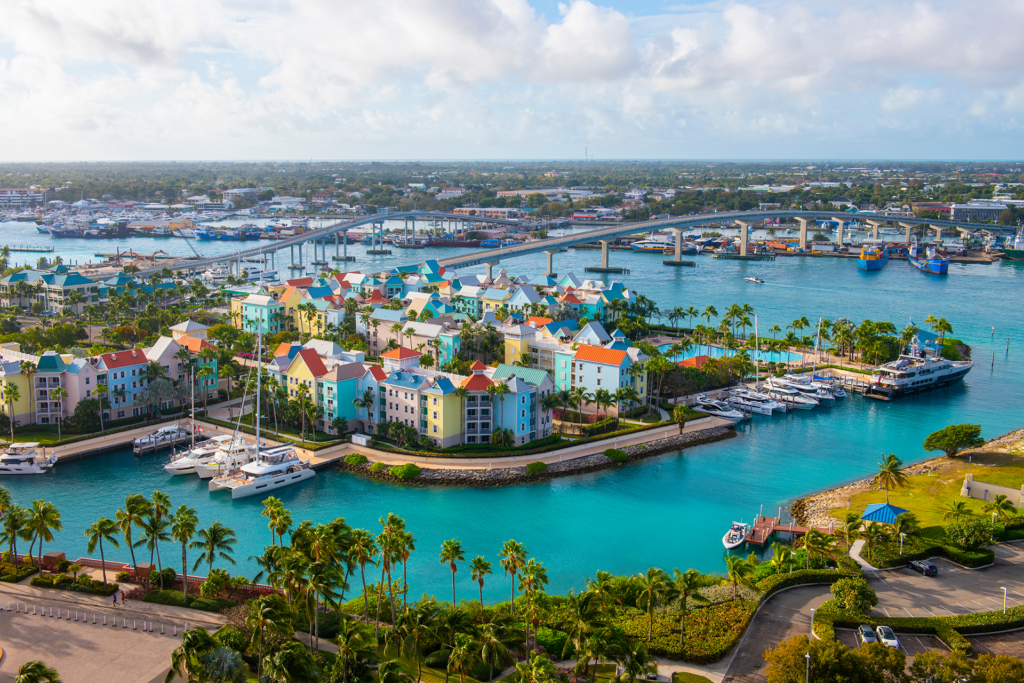
Tampa’s international connections continue to grow—this time with the return of nonstop service to Nassau, The Bahamas.
Breeze Airways recently launched nonstop service between Tampa International Airport and Lynden Pindling International Airport in Nassau, marking the airline’s first-ever international route from Tampa and the first nonstop jet service between Tampa and Nassau in 20 years. The new route began with twice-weekly flights on Thursdays and Sundays, with service expanding to four days a week in July.
For many travelers, the announcement may sound like a convenient new vacation option. But for Tampa, it represents something much larger.
Direct flights do more than shorten travel time. They shrink the perceived distance between communities. They make business meetings easier to schedule, family connections easier to maintain, cultural exchanges more practical, and tourism more accessible. They also signal confidence: airlines launch and expand routes when they see demand, opportunity, and long-term potential.
That is why this new Tampa-to-Nassau route matters to the mission of the Tampa International Diplomacy and Exchange Summit, or TIDES. TIDES is built on the understanding that international relationships are not created only through formal agreements. They are strengthened through repeated interactions—through travel, trade, education, investment, culture, and personal connection.
A nonstop flight makes those interactions more likely.
Direct Air Service Creates Real Opportunity
When a city adds or restores a nonstop international route, it gains more than a line on an airport map. It gains a new corridor of opportunity.
For tourists, nonstop service lowers friction. A trip that might have required a layover, longer travel time, or a less convenient itinerary becomes easier to imagine and easier to book. That can increase visitor flow in both directions—Tampanians traveling to The Bahamas and Bahamians visiting Tampa Bay for shopping, sports, medical care, education, business, or family travel.
For businesses, direct flights can influence whether a market feels accessible. Companies exploring partnerships, conferences, supplier relationships, or investment opportunities are more likely to consider destinations that are easy to reach. A direct connection can turn a one-time trip into an ongoing relationship.
For civic and cultural institutions, air service can support exchanges that would otherwise be more difficult to organize. Universities, chambers of commerce, arts organizations, tourism leaders, and local governments all benefit when travel logistics become simpler.
This is especially important for Tampa because the city has long understood the strategic value of transportation. Tampa’s growth has always been tied to its ability to connect people and markets.
Tampa’s Caribbean Identity Runs Deep
Tampa’s modern international ambitions are not new. They are rooted in the city’s history.
In the late 19th century, Tampa’s rise was shaped by rail, steamship service, the port, and its connections to Cuba, Key West, and the wider Caribbean. Henry Plant’s railroad and steamship network helped transform Tampa from a relatively isolated Gulf Coast town into a gateway for commerce, migration, and travel. Port Tampa became a key transportation hub, and the city’s cigar industry grew because Tampa could move people, raw materials, and finished goods efficiently.
The result was not only economic growth. It was cultural transformation.
Ybor City and West Tampa became home to immigrant communities from Cuba, Spain, Italy, and other places, creating a distinctive international identity that still defines Tampa today. The city’s food, architecture, politics, labor history, music, and civic culture were all shaped by these cross-border connections.
While much of Tampa’s Caribbean story is often told through its ties to Cuba, Tampa’s location has always placed it within a broader Caribbean basin. The Bahamas, like Tampa, sits at the intersection of tourism, maritime history, trade, and cultural exchange. Nassau’s renewed direct connection to Tampa is a reminder that Tampa’s international identity extends beyond any single country or relationship.
It is part of a regional story.
Why This Matters for TIDES
TIDES is about positioning Tampa as a city that understands international engagement as a practical strategy for economic development, cultural connection, and civic leadership.
The new Nassau route fits directly into that vision.
It gives Tampa another international connection in the Caribbean. It strengthens Tampa International Airport’s role as a regional gateway. It creates new possibilities for tourism partnerships, business development, educational collaboration, and cultural exchange. It also offers a timely example of how infrastructure—especially air service—supports diplomacy at the human level.
Diplomacy is often imagined as something that happens in embassies, city halls, or formal summits. But international relationships are also built in airports, classrooms, hotel lobbies, restaurants, business meetings, and family visits. A direct flight makes those moments easier to create.
As Tampa prepares for TIDES, the return of nonstop service to Nassau offers a powerful reminder: global cities are built through connectivity. Every new route expands the map of what is possible.
For Tampa and The Bahamas, this flight is more than a travel convenience. It is an invitation—to visit, to collaborate, to invest, to learn, and to strengthen the ties between two communities connected by geography, history, and opportunity.
The distance between Tampa and Nassau has not changed. But with nonstop service, the relationship feels much closer.