
When people think about what makes a city truly global, they often start with the obvious measures: international flights, ports, foreign investment, tourism and multinational companies.
But some of the most important indicators of a global city are less visible.
They include the quality of its universities, the strength of its research institutions, its ability to attract talented people from around the world and whether organizations outside the region see it as a place worth partnering with.
That is why the latest national recognition for the University of South Florida matters well beyond the university itself.
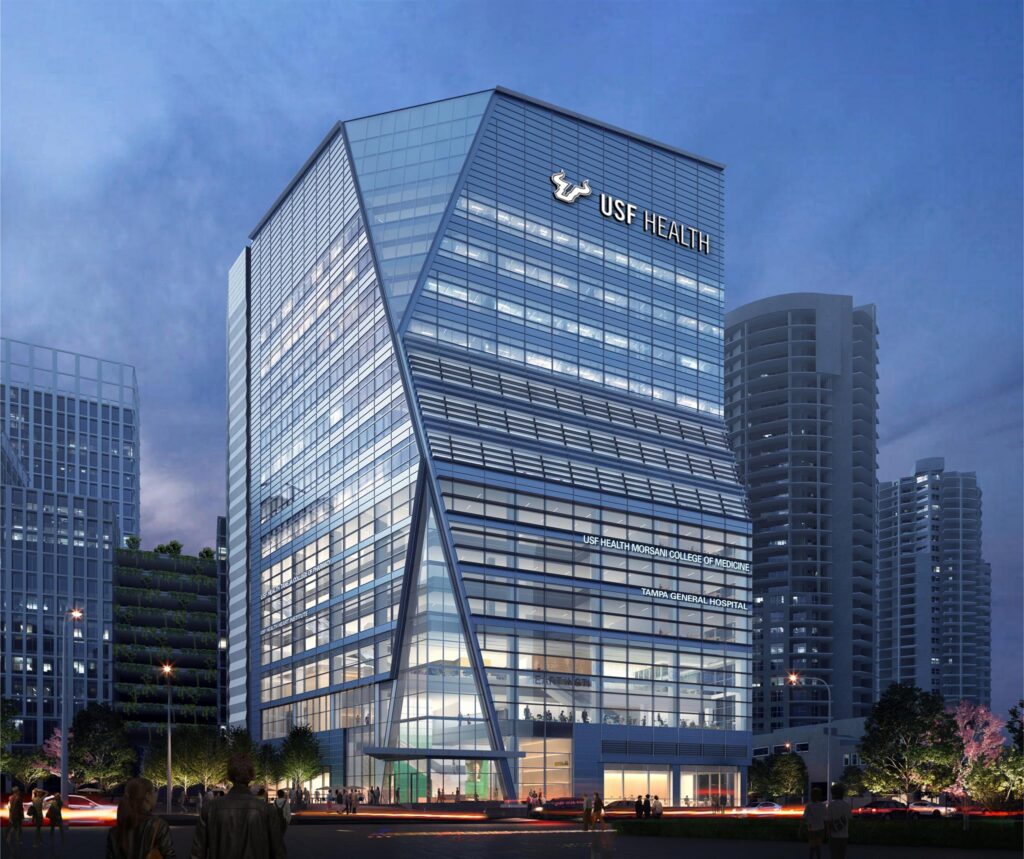
The USF Health Morsani College of Medicine has been ranked No. 1 in the nation for the second consecutive year in the 2026 Medical School Excellence Index, receiving the only perfect score of 100 among U.S. universities. The recognition follows another major distinction earlier this year, when Morsani received the highest possible Tier 1 designation for research from U.S. News & World Report.
Those are impressive achievements for USF. They are also important assets for Tampa.
Global Cities Compete for Talent
One of the defining characteristics of internationally competitive cities is their ability to attract people.
Researchers, physicians, entrepreneurs, students and companies increasingly have choices about where they locate. The reputation of a region’s universities can play an important role in those decisions.
USF Health’s latest incoming medical class, for example, entered with a median MCAT score of 521, placing those students among the top 2 percent nationally, and a median GPA of 3.98.
When an institution in Tampa attracts that level of talent, the benefits extend beyond the classroom.
Some graduates stay in the region. Researchers establish laboratories and partnerships here. Physicians build careers here. Entrepreneurs create companies around discoveries made here. Other universities and institutions become more interested in collaborating with Tampa-based researchers.
Over time, that concentration of talent becomes part of a city’s international identity.
Reputation Creates International Opportunities
Global partnerships rarely begin with geography alone. They begin with credibility.
An overseas university considering a research partnership, a biotechnology company evaluating a U.S. location or an international physician looking for an academic collaborator will naturally look at the quality of the institutions already operating in a region.
National rankings are not the only measure that matters, but they provide an easily understood signal.
A university with nationally recognized medical education and Tier 1 research capabilities tells the outside world that Tampa is not simply a growing metropolitan area. It is a place where sophisticated research, medical education and innovation are taking place at a high level.
That distinction can open doors.
It can lead to joint research programs, faculty exchanges, international students, clinical collaborations, commercialization opportunities and relationships with companies looking for access to research talent.
And those relationships often create additional connections that reach into trade, investment and economic development.
Health and Life Sciences Are Increasingly Global
Medicine has always crossed borders, but modern health care and biomedical research are especially international.
Research teams collaborate across countries. Clinical discoveries move between universities and health systems. Biotechnology companies seek scientific talent regardless of geography. Diseases do not respect national borders, making international cooperation essential in public health and medical research.
A highly regarded academic medical institution therefore becomes part of the international infrastructure of the city around it.
For Tampa, USF Health’s growing national profile creates another reason for researchers, health systems, universities and companies elsewhere in the world to look toward the region.
That matters because global cities are built through networks.
The more meaningful connections Tampa’s institutions have with organizations elsewhere in the world, the more Tampa itself becomes embedded in international networks of knowledge, commerce and innovation.
Universities Are Part of a City’s Global Infrastructure
Airports and ports are often described as gateways to the world. Universities serve a similar function.
They bring international students and scholars into a community. They send faculty and students abroad. They build research relationships across borders. They convene experts around global problems and frequently introduce businesses and institutions to partners they otherwise would never encounter.
Those relationships may begin academically, but they do not necessarily stay there.
A research collaboration can eventually lead to a startup. A visiting scholar can create a relationship between two institutions. An international graduate may become a business or civic leader who maintains connections with Tampa for decades.
This is one reason strong universities are found at the center of many of the world’s most internationally connected metropolitan regions.
The Spotlight Extends Beyond USF
There is also a reputational multiplier at work.
When a Tampa institution earns national recognition, the name Tampa travels with it.
Someone reading about a nationally ranked medical school may know very little about the region beforehand. The recognition creates an introduction.
The same principle applies when Tampa International Airport receives recognition, when the Port of Tampa attracts new international business, when a local company expands overseas or when Tampa organizations establish partnerships with counterparts in another country.
Individually, these accomplishments belong to different institutions.
Collectively, they shape how the world perceives Tampa.
That is ultimately how the identity of a global city develops—not through a single designation, but through a growing collection of internationally relevant institutions, relationships and accomplishments.
Connecting Those Assets
The next opportunity for Tampa is not simply to accumulate strong institutions, but to connect them.
Universities need relationships with international businesses. Researchers need connections with entrepreneurs and investors. Companies need access to talent. International delegations need ways to discover opportunities within the region. Civic organizations can help establish relationships that later become educational, cultural or commercial partnerships.
Creating those intersections is one of the ideas behind the Tampa International Diplomacy and Exchange Summit (TIDES).
USF and USF Health will be among the organizations participating in TIDES this November alongside representatives from business, government, education, diplomacy, innovation and international organizations.
Their participation is significant not simply because USF is one of Tampa Bay’s largest institutions.
It is significant because institutions such as USF demonstrate something increasingly important about Tampa itself:
The region is developing assets that give people and organizations around the world a reason to connect with Tampa.
A No. 1 medical school ranking is therefore more than a point of local pride.
It is another piece of the infrastructure required for Tampa to become a genuinely global city.