Before Cigars: Tampa’s First International Trade Story
Tampa’s international trade story did not begin with cigar factories, steamship schedules, or railroad timetables. Those developments would later transform the city and help make Tampa internationally known. But before Ybor City became a global cigar capital, and before Henry Plant connected Tampa more fully to national and Caribbean markets, Tampa’s earliest modern international trade story was already taking shape across the waters of the Gulf.
It began with cattle.
In the mid-19th century, Tampa was still a small frontier settlement on the edge of a vast bay. Its population was limited, its roads were poor, and its connections to the rest of Florida and the United States were difficult. But Tampa had one great advantage: water. Tampa Bay opened to the Gulf of Mexico, and the Gulf opened to Cuba and the wider Caribbean.
That geography gave early Tampa something powerful. It gave the city a way out.
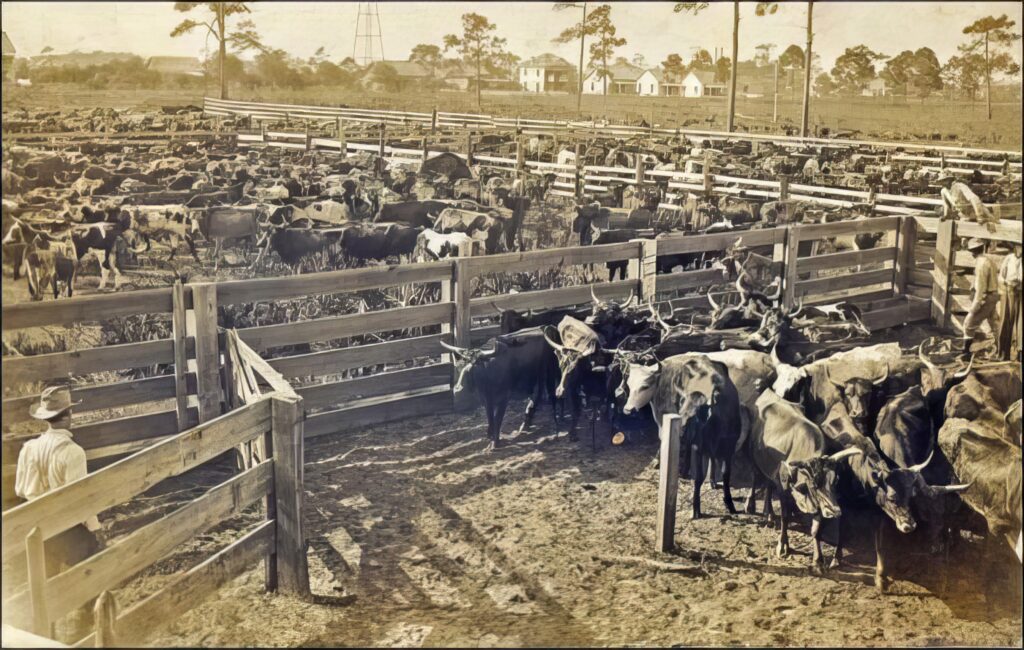
For Florida cattlemen, Cuba offered a market. For Tampa, the cattle trade offered one of its first sustained commercial connections beyond the United States. Capt. James McKay Sr., one of early Tampa’s most important civic and commercial figures, helped build that connection. In the 1850s, McKay used sailing and steam vessels to move cattle from the Tampa Bay region to Cuba, creating what may be considered Tampa’s first major international trade relationship.
This is where Tampa’s international commercial identity begins: not with a finished product or a famous brand, but with ranchers, ships, cattle, and a nearby island market.
The trade was practical. Florida had cattle. Cuba needed beef. Tampa had a bay that could connect the two.
That simple equation helped define a pattern that would repeat throughout Tampa’s history. The city’s growth has often come from linking local assets to international demand. In the cattle era, the asset was Florida livestock. The market was Cuba. The connector was Tampa Bay.
This early trade also reminds us that Tampa’s international identity was never separate from its geography. The bay was not just scenery. It was infrastructure. It was the reason Tampa could look outward before it had the population, capital, or industrial base of larger cities.
The cattle trade with Cuba did not make Tampa famous in the way cigars later would. It did not create a neighborhood as iconic as Ybor City or build institutions that still define Tampa’s cultural landscape. But it did something essential: it proved that Tampa could participate in international commerce.
It showed that Tampa’s future was connected to the Caribbean.
That matters because the Caribbean would remain central to Tampa’s development. Cuba, especially, would become one of the most important places in Tampa’s story. Long before Cuban tobacco shaped Ybor City and long before Cuban political organizing made Tampa a stage for international history, Cuban demand helped give early Tampa one of its first foreign markets.
The cattle trade was also part of a larger frontier economy. Cattle moved from inland Florida toward coastal shipping points. Ships carried them across the Gulf. Merchants, captains, ranchers, and buyers created a commercial network that linked rural Florida to the Caribbean. Tampa’s role in that network was still modest, but it was real.
And because the trade moved through Tampa Bay, it helped establish the city’s earliest function as a gateway.
That word — gateway — is important. Tampa did not become international simply because people declared it so. It became international because goods, people, ideas, and opportunities moved through it. The bay made movement possible. The cattle trade made that movement commercial. Later industries would expand the scale, but the logic was already present.
Tampa’s earliest international trade story is therefore not just about cattle. It is about the beginning of a civic pattern.
Tampa has always advanced when it connects what the region produces with what the world needs.
In the 1850s, that meant cattle and Cuba. Later, it would mean transportation, tobacco, phosphate, tourism, finance, defense, education, technology, and global partnerships. But the first chapter belongs to the ranchers and ship captains who recognized that Tampa Bay was more than a local harbor.
It was an opening to the world.